
Discovering You Have Stage Four Melanoma: How to Handle the Diagnosis
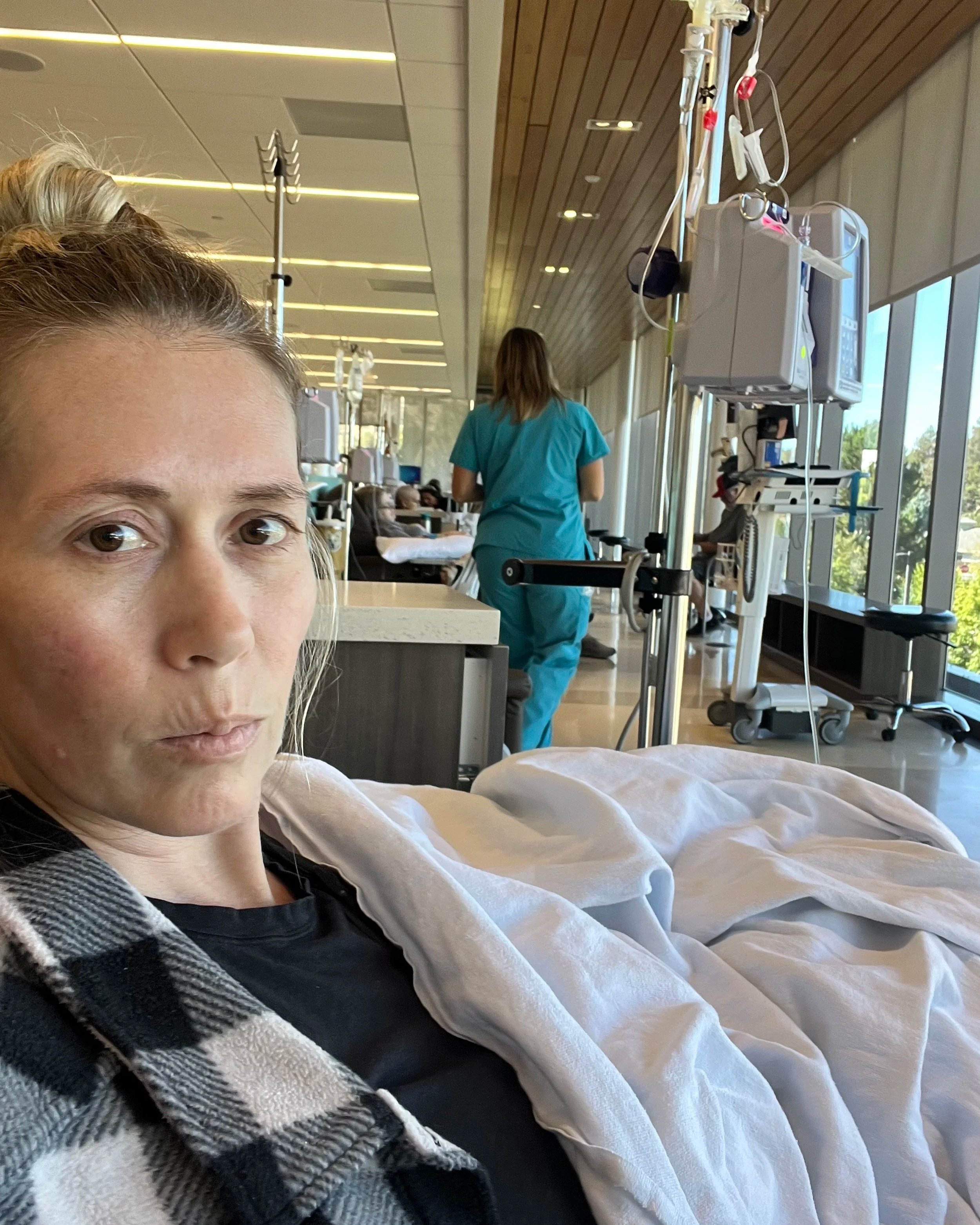
Me, during treatment.
In August of 2025, I discovered that I had stage four Melanoma. This is my story, and insights on how I learned (very quickly) to manage and move forward with the diagnosis in the first month.
I sat in the neon-fluorescent-lit patient room at Urgent Care, which felt more like a cubicle than a room. To the right of me, I could hear a man violently throwing up, and one of the staff members saying, “This is a problem for the ER,” and to my left, a baby was coughing and crying.
The clock on my phone read 1:17 pm. Had I really been here since six forty-five?
A flurry of activity was taking place outside my door—low voices, talking in a fast and concerned tone. I jumped a little when the Physician's Assistant who’d been with me all morning opened the curtain and came in.
I remembered, as she entered the room, that I had overheard her tell her nurse she was trying to get out of work at 1pm. It was now well past that time, and I thought, maybe she’s transferring me to someone else?
Instead, she sat down on a rolling stool and scooted up close to me.
“The scan came back,” she said in a far too serious tone. “It looks like you have a mass on your pancreas. And something else is going on with your liver.”
You know how they say when you get life-altering news, some people stop hearing properly, and the world slows down?
That didn’t happen to me. Everything sharpened. As if the words coming out of her mouth were clipped and had hard and sharp edges.
“Okay,” I finally said. The tissue I was holding in my hand was ripped to shreds. “What does this mean?”
“It means,” she said, “ that you most likely have cancer. The mass is large. We need you to go to the hospital now for more comprehensive care and testing.”
My hands were shaking. But I couldn’t feel it. It was as if I were outside my body, looking at someone else.
“My husband,” was all I could choke out. “I need to call my husband.”
I never went home that day. I drove, in a daze, to pick up my husband while he frantically called his parents to take the kids, packed them up, and dropped them off with some excuse for why Mom wasn’t coming home.
We drove to the hospital in silence. I was admitted to the hospital, and within 10 hours, I was told that I had stage four pancreatic cancer that had spread to my liver and was affecting two of my lymph nodes.
The following days were measured by minutes, and yet went by in a blur of blood draws, nurses coming into my hospital room at regular intervals to check my vitals and give me medication. I could barely eat because my digestive system was shutting down. I couldn’t really sleep because of the pain and anxiety, and I was paralysed with not just fear, but terror.
As the week progressed, the oncologist, who was assigned to me when I checked into the hospital, and the gastrointestinal team, who was in charge of all of the craziness happening in my digestive system due to the cancer they had found there, informed me that I most likely had necrotic pancreatic cancer.
This was a shock because the people who usually discovered this kind of cancer were predominantly male, over sixty years old, and sometimes long-term alcohol abusers. While I was no saint and drank my fair share of alcohol, even the team at the hospital was in shock with this diagnosis.
To be on the safe side, my oncologist decided to perform two biopsies – one of my liver and one of my pancreas to see if it actually was traditional pancreatic cancer. Because if it was, I was looking at weeks, maybe months, or a year to live.
My mind literally couldn’t compute it. We had just planned a camping trip, and the kids were about to start the school year. I couldn’t be dying. I’m a mom and a wife. I need to be here for my family and friends. And I have so much more life to live!
After almost four days of nothing but bad news layered upon worse news, layered upon a severe decline in my overall condition, which led to an emergency procedure to install a temporary biliary drain in my bile duct system, because all of my stomach and intestines were inflamed and liquid and food literally couldn’t get through.
After calling our close friends and family, deeply sobbing, discussing, and zoning out in disbelief, then trying to wrap our heads around the direness of the situation, my husband and I received the best news someone who has stage four pancreatic and liver cancer can get.
Some of our best friends were visiting my hospital room. In the drug and depression-induced fog, in which I was trying to put on a good face and smile, I tried to talk about anything that wasn’t future-related.
That’s when the nurse practitioner who supported our GI team came in.
“I have some news,” she said. “Your biopsy results have come back.”
I felt my chest tighten as I prepared for the worst.
She looked over to my husband and our friends.
“It’s okay if they hear this,” I said.
“Okay,” she said with a sigh and a slight smile. “Well, the good news is that you don’t have necrotic pancreatic cancer. You actually have melanoma that has manifested in your pancreas and liver.”
This is something my husband and I knew could be a slight possibility. I had melanoma in my twenties, and the cancerous mole had been removed.
Throughout this week from hell, my husband kept saying to the doctors, and promptly being dismissed, “Could this be melanoma?”
I felt a collective gasp and sigh of relief in the room. The Gastrointestinal Nurse was now smiling. My husband was gasping, “Oh my God, thank God.”
I felt all the emotion well up in my system, and I just started bawling my eyes out.
“This means, the nurse continued, that we can treat your cancer, even at this stage. We can start you on what’s called Immunotherapy. And the great news is that with immunotherapy, your chances of survival can increase by 40% or more. Some call it a miracle treatment.”
I could barely hear her through my tears, the letdown, relief, and joy.
I’m sharing my story with you, in case you or someone you love has recently been diagnosed with a late-stage cancer.
Let me stop here and acknowledge that if you’ve found this post, I know that where you are at absolutely blows. You’re right; it’s not fair. And no, it shouldn’t be you or them, but it is.
So if this is you (or someone you love), and you are going through the process of accepting a new cancer diagnosis, and trying to figure out what’s next, here are a few things that I found helped me through the first month of learning that I had stage four melanoma in my pancreas and liver.
You’re Right; This is Unfair (in fact, it’s F*cked Up)
I personally have found very little content online discussing and truly exploring the parts of a cancer diagnosis that are too hard to talk about. It is all so confusing. One minute you’re living your life, and the next you’re living what feels like someone else's life entirely. A life dominated by appointments, side effects, pain, feelings of loss, actual loss of identity, and a reforming of your reality. And it all just feels so, so unfair, and f*cked up.
Acknowledging the insanity and the crushing reality you now find yourself in is an important step in finding a way to move forward with strength and acceptance as you navigate living with and treating stage four cancer.
Let Yourself Be in Shock
No matter how much you might think you will be able to handle news like receiving a cancer diagnosis, when it actually happens, you’re not prepared. Not just for the amount of information that is thrown at you in those first days, where you’re discovering how serious the diagnosis is, and what the recommended treatment will be; you’re also wrestling with all of the internal calculations and questions that start to arise, like:
How will this change my life?
Will I survive this?
What about my family? My children? My partner?
How will I work and keep up with my responsibilities?
The list goes on…
If you have recently been diagnosed with cancer, or a loved one in your life has been, these are likely some of the things running through your brain on repeat, and it can make you feel like you’re floating above your body, living someone else’s nightmare of a life. Am I right?!
So, instead of adding one more layer of pressure and stress on yourself to “buck up,” and get it together, and “fight the good fight,” for this moment, just let yourself be in shock.
I promise, this moment will pass, and you will click into an “I’ve got this gear,” At least that is my prayer for you. But when you are first diagnosed with cancer, I don’t care if it’s stage one or stage four; shock and confusion are the first reactions, and that is okay. Let it be. And it will pass.
Let Others Take Over
When I was diagnosed with stage four cancer, everything happened so fast. One moment, I was talking to my husband about going to urgent care because I couldn't keep food down. The next, I was calling to tell him that he needed to come with me to the hospital.
Over the course of the next few weeks, we were in and out of the hospital a few times, managing procedures, appointments, and planning for treatment.
Everything in our normal day-to-day life ground to a halt, except for the things we could let other people we trusted help us with, and do for us.
We relied heavily on family and friends to pick up and drop off our kids, help with groceries and errands, and anything else we could think of that needed doing.
In our case, we had no choice. I was in the hospital, and my husband wanted to be there with me, so we had to rely on others. But even if you’re feeling capable of doing all the things you usually would do, I would highly recommend that you allow someone or a few trusted people to support your needs in this first month while you grapple with your cancer diagnosis.
Instead of going grocery shopping, plan a walk (if you are able), visit a close friend, or simply take some time to journal and meditate.
Create an Anchor for Yourself
Something I started before I was diagnosed with cancer, and has saved me throughout the darkest moments of my cancer diagnosis and healing process so far, is the action of having something ritual-like that I do every single day. For me, this has been my Gratitude and Manifestation Journal.
Every single day, I sit down with my tea or coffee after I wake up and open a new email – if you’re not in a place where you get out of bed, do something like this for yourself from bed. I then write myself a message with the following prompts:
What am I grateful for today?
What am I letting go of or releasing?
What am I manifesting and bringing into my life?
What am I affirming?
I list everything I can think of for these prompts, then send it to my own inbox. Sometimes I look at it again later in the day, sometimes I just file it away. Either way, it helps me ground myself and get present for the day.
Alternatively, you can find a daily affirmation or a book of affirmations to read alongside or instead of journaling. At the end of the day, just do what feels right and isn’t stressful. With everything else you have going on, added stress is the last thing you need.
Here is the affirmation book my mom sent me, which got me through some very dark moments, and still does.
You Are Not Okay, and That’s Okay
No matter what, learning that you have cancer is an absolutely shitty pill to swallow - total pun intended! There is no good way to receive news of a diagnosis, and it is okay to feel there is no silver lining or light at the end of the tunnel.
But I am here to tell you that you are not alone. I know what you are going through. I know how lonely, terrified, and completely powerless you are feeling right now.
I’m also here to tell you that you are not okay, and that is okay. And you are here in this moment with love surrounding you. I am sending love to you. There are people in your life and world who love you. You are strong, and you will get through this moment.
Whatever that looks like for you, there is power in knowing that you will be okay. Regardless of the outcome. Regardless of uncertainty.
Sending you peace, acceptance, and love.
I’m Here With You!
If you want to share your story with the Womanhood Unwrapped community, please reach out! I would love to connect with you and tell your story.